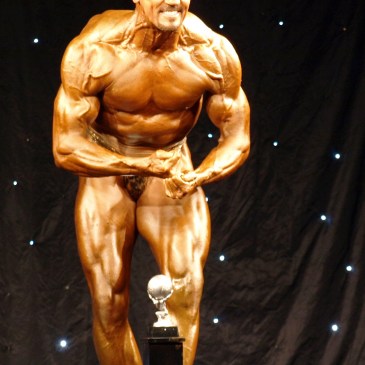
CW’s Training Tip #14

Sometimes less can mean more!!!


I have watched and listened to Dave Palumbo’s Heavy Muscle Radio Show and Ask Dave TV Show for several years now and really like Dave’s no nonsense approach towards training and nutrition.

He has said that the best results he got from his training was by working each body part on their own day and training 5 or 6 days per week.

So here is my version of this where I will integrate my HIT style training with each workout…

Monday: Quads & Calves
Tuesday: Chest
Wednesday: Biceps
Thursday: Hamstrings & Calves
Friday: Triceps
Weekend: Off
Monday: Back & Traps
Tuesday: Shoulders
Wednesday: Workout cycle repeats.

This regime will allow me to hit each body part intensely once every 9 days and indirectly twice with some secondary work from other body part workouts.

It will also allow for maximum recovery and subsequent growth, without overtraining.

As 8 time Mr Olympia, Lee Haney, once wisely said…

“Stimulate, not annihilate!!!”

Always worth trialling something different I reckon.

CW’s Training Tip #13


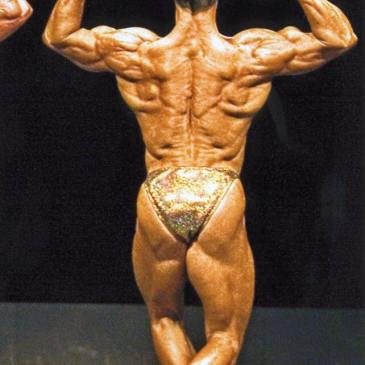
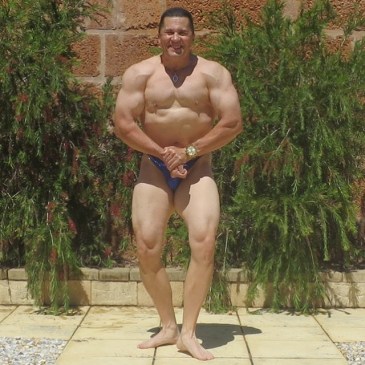
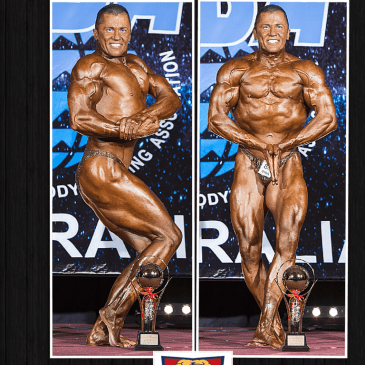
Again, not a training tip today, but I thought I would break down the intracies of my personal favourite compulsory pose…“Back Double Biceps”.

Men, in general, can usually get in great shape from the front, but what seems to sort out the pack is whether or not the hamstrings/glutes and lower back tie-ins are in condition and that combined with the upper back musculature ‘popping’!!

They say the show is won from the back, so obviously one needs to (a) be lean enough in this area and (b) be able to present it to the audience and judges in the optimal way that suits your physique.

Here are 7 pointers that may help you…

1. Start from the ground and work your way up.
I like to begin by placing my back leg in position so as to show off the glute/hamstring tie-ins as well as that calf. My legs are quite long so I place my back leg directly behind my back, put the ball of my foot firmly on the floor, ‘screw’ the back leg down into the stage whilst simultaneously flexing the upper hamstring and glute of the trailing leg. Leaning back onto the flexed trailing calf will also help keep the glute and hamstring looking tight.

2. The other option with your back leg, if it is shorter and well developed, is to place it more to the side whilst turning the knee out at about 45 degrees. This then enables you to tense and flex the entire length of the hamstring, sit back on a flexed (and hopefully striated) glute whilst showing off a bit of outer thigh sweep as well.

3. Now for the upper back.
A good way to hit this part perfectly is to place your outstretched arms, with forefingers touching and palms face down, directly in front of you parallel to the floor.
Next, rotate your arms back in opposite directions, out to the sides, palms still face down, into a ‘crucifix’ position with arms still parallel to the ground. This now not only looks spectacular with all the upper back musculature bunched together creating a really gnarly 3D appearance, it also places you in a square and balanced position so as to then flex the biceps.

4. From this so called crucifix position now reel in your wrists with thumbs tucked into your fists.
Make sure you now spread the scapulae from its previously bunched together state whilst flexing your biceps. The transition from the crucifix pose to the back double biceps pose when done correctly really does look impressive.
Importantly, your fists should line up with the top of your head. If they drop lower than this there is then the risk of your upper back being still bunched together and looking too narrow.

5. You’re almost finished now!
Finally tweak your elbows slightly towards the back drop whilst simultaneously flexing down on your lats. Try to keep everything else stationary whilst doing this, which again includes maintaining the horizontal line with your fists and the top of your head.

6. Lean back slightly towards towards the judging table, but not too much, as you don’t want any crinkles or wrinkles emanating from the lower back or bottom of the glutes.

7. And with all of the aforementioned, don’t forget the golden rule of NOT LOOKING DOWN!!!

Back double biceps is a sensational pose if you can get it to pop, so hopefully some of these tips may enable you to do just that the next time you’re on stage!

PS: Don’t forget my Posing ebook is now for sale for only $20. Send me an email or message via the contact link on my website to arrange payment and download.

CW’s Training Tip #12

“GOT TRAPS!!??”

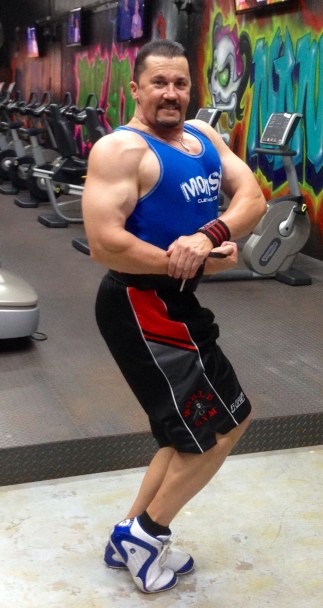
Here’s tonight’s Back & Traps workout at the awesome Gold’s Gym, Rockingham…

  1.  Wide grip front chins
  2.  Reverse close grip pulldowns
  3.  Seated plate-loaded underhand grip rows
  4.  Seated close grip cable rows
  5.  Plate-loaded machine shrugs

I have always been a firm believer that the trapezius is part of the back musculature as it’s function is basically to pull.

The plate-loaded shrug machine at Gold’s is an absolute cracker, as it really allows you to hit the spot with minimal stress on the lower lumbar area.

Training traps at the end of your back workout is definitely the way to go!

For more videos with accompanying discussion & tips, visit my YouTube Channel “Craig Winter”.


CW’s Training Tip #11

Today, I thought I would touch on some posing advice with probably the most underrated, yet important poses of them all…”Face Front”.
It took me years to try and master this pose which is often referred to “standing relaxed”.
And standing relaxed couldn’t be any further from the truth!!
The judges are literally assessing you in this pose more than any other and will be even judging you in this position when you are stood back in the lineup whilst they judge those that have been called forward for closer inspection.
It is very much an individual pose to create according to your own physique, but there are some general guidelines I thought I would discuss.
1. When walking onto the stage always keep your head up, make eye contact with the audience, smile, keep your chest up and hold your waist tight.
2. Once at your designated stage spot now start from the ground up. Feet sound be placed at 45 degrees (“duck feet”) with heels about 10-15cm apart so that the top of your adductors are just touching.
3. Now push the weight to the outside edges of your feet whilst simultaneously bending your knees just slightly. Try to visualise the ‘splitting of your quads’ with that outer sweep flaring out and around the vastus intermedius.
4. Next flex down on your abdominal wall whilst shrugging your shoulders up, out to the sides and down onto your flared lats. Tuck your thumbs into your fingers, keep the back of your hands in a straight line with your forearms (ie; NO LIMP WRISTS!!!) and punch your fists down towards the ground, NOT towards the audience. You are not riding a motorbike folks!! This in turn will enhance your V-shape, whereas the latter will make you look narrow and straight up & down.
5. At this stage the focus on your breath is critical. Try to imagine air being pumped into your rib box whilst simultaneously being sucked out of your stomach. The best way I have found to achieve this to slowly breath in through your nose and fairly promptly out through your mouth. Many nervous breaths in and out of your only the mouth will result in your rib box collapsing and hence a smaller looking upper torso and bigger stomach/waist. Also, this process of deliberate breaths in through your nose and out of the mouth is akin to how meditation works, so if done properly it can help ease your nerves and/or anxiety.
6. Whether to flex the lower pecs is now an individual dilemma. I have found that keeping the pecs relaxed gave them a fuller & rounder appearance. Guys with very overdeveloped lower pecs may wish to flex them so as to create a harder more defined & balanced look when compared to their upper chest.
7. Once in position it is now important to occasionally refresh or reboot your upper torso. To do this simply repeat my earlier key thoughts of shrugging the shoulders up around and down onto your flared lats whilst simultaneously concentrating on your breath in through the nose and out of your mouth. Remember to keep flexing down on your abdominal wall. This does take some time to master, but with practice you’ll get the idea. And don’t forget, no limp wrists, whilst punching your fists down towards the ground!!
8. Don’t forget about your lower body key thoughts either (ie; points 2 & 3).
9. I will occasionally do a ‘sneaky’ palms together most muscular so as to attract the judges attention and maintain my pump in the pecs and delts. I will quickly then return back to ‘face front’.
10. The whole time you are in this position remember to smile, never look down and try to make as much eye contact with the audience and judges as you can. If these people see that you are relaxed, confident and enjoying yourself then mark my words, they will be drawn to looking at YOU like the proverbial moth to a flame!!!
In closing, I will reiterate that this pose needs customising to suit your physique. But I think you will find that some of these tips should assist you in creating your own awesome version of “Face Front”!!

PS: Don’t forget my Posing ebook is now for sale for only $20. Send me an email or message via the contact link on my website to arrange payment and download.

CW’s Training Tip #10

“Ways to enhance your hormones, naturally!!”

Ok people, this time around I would like to focus, on not a training tip per se, but something that will indirectly improve both your ability and desire to workout.

Optimum hormone production is paramount at any age, but even more important when ‘father time’ starts to kick you in the derrière!

I have been monitoring my hormone levels for some time now, via blood work, and have seen improvements in several markers due to holistically incorporating a number of different aspects into my lifestyle.

These 4 supplements I have been using are definitely worth looking into:

1. Eurocoma Longolia (Tongkat Ali), to boost your own natural testosterone levels.

2. Avena Sativa, to assist in testosterone availability (higher free testosterone) by lowering oestrogen levels as well as helping the body remove those harmful Xenoestrogens that we accumulate from deodorants, pesticides, GMO meats, plastic bottles and the list goes on!!

3. Saw Palmetto, to help minimise conversion of testosterone to DHT. And because of this it can then help minimise benign prostate enlargement as well as male pattern baldness.

4. Chrysin topical cream, to once again assist in lowering oestrodial. I get mine through a compounding chemist at Rockingham Pharmacy in Kent Street or Hamilton’s Componding Pharmacy in Canningvale.

Please note: lowering oestrogen is only important if your levels are too high. As men age this phenomena is very common. Checking your levels via blood work through your local GP is strongly recommended before trialing any of these supplements.

I have also altered my macronutrient ratio so as to incorporate more essential fats in my diet. Fats can certainly help boost testosterone production whereas as the high GI sugary carbohydrates can potentially lower it.

My protein: carbs: fat ratio is now approximately 35:20:45.

I would highly recommend increasing your consumption of cruciferous vegetables (eg: Cauliflower, Broccoli, Spinach, Cabbage, etc), as these also greatly assist in removing these annoying & toxic Xenoestrogens.

The icing on the cake in attempting to optimise hormones is to also engage in weight training and/or HIIT sprint based exercise. This is a proven winner!!

It is quite amazing at just how a small improvement in your hormone levels can positively affect the way you both look and feel.

And all of this I have discussed today involves zero PEDs.

CW’s Training Tip #9

“CW’s Version of HIT explained…”

fullsizerender-4

Just recently cranked out an awesome chest workout at the new Gold’s Gym Rockingham where, in true Gold’s fashion, they have an apparatus for every conceivable angle!!

  1. Flat dumbbell bench presses 3 sets 15/12/8 reps
  2. Rocking decline machine presses 3 sets 15/12/8 reps
  3. CW’s hybrid incline fly-presses 2 sets 12/9 reps (with drop set*)
  4. Cross bench dumbbell pullovers 2 sets 12/9 reps
  5. Seated pec deck 2 sets 15/12 reps

Total duration: 40 minutes!

The basic premise with this style of training (High Intensity Training) is to put everything you have into the last set on each exercise.

And if you can’t get to positive failure on that set I then like to do an immediate drop set* for about 12-15 reps with approximately half the weight.

Importantly, the one or two lead up sets of 15 and/or 12 reps are performed NOT to failure and are simply getting you prepared for the final all out set.

This way you don’t burn yourself out with all those extraneous sets and allow yourself to be stronger for that last set.

To optimise that final set you can use other principles to take it past positive failure such as forced reps (with a reliable training partner) with deliberate negatives, cheat reps, partial reps, descending sets, etc.

BUT, as always, be mindful of form when going beyond failure.

This type of training brings quite rapid results, increases in strength, allows for recovery and will give you a renewed enthusiasm for training at the gym.

After about 8-10 weeks it is then a good idea to back off the weights slightly for a couple of weeks with perhaps a bit more volume and not going to failure.

The video below is also worth a look, as the principle behind HIT training is well covered by legendary 6 time Mr Olympia, Dorian Yates…


CW’s Training Tip #8

piccollage-3

“DELT PRESSER OR PEC PRESSER!!??”

I have been a chronic deltoid presser for all the years I have trained and have worked hard these past few years to try and press with my pecs and consequently take the load off my battered ACL joints.

While I was in Melbourne I went to see Myotherapist, Michael Bordignon, who operates from his clinic next to Doherty’s headquarters in Brunswick.

He showed me how to pinch my shoulder blades together and keep them there throughout the entire movement by practicing against a vertical wall. And to do this in between my sets of dumbbell presses.

The key thought here is to literally keep your shoulders ‘down and back’ during both the eccentric and concentric part of the pressing motion. Minimizing the front deltoids action is what you are trying to achieve all whilst increasing the involvement of the pectoral muscles.

I find that by putting a 10cm high step under the bottom end of the bench, thus creating a slight decline, really helps you use gravity to ‘calm down’ those eager deltoids.

The other exercise I like to do after the aforementioned dumbbell presses is my hybrid incline dumbbell fly/ press.

The key to this great upper pec mass builder is to tuck your chin into your chest, again keep your shoulders ‘down and back’ and then try to bring your upper pecs (near your collarbone) into your chin at the top of the movement so as to create a peak contraction right where you need it.

Just be sure to set the incline bench at only 30 degrees or so.

Check out my vid from my YouTube channel “Craig Winter” and you’ll get the idea.

I then like to finish my chest workout with 2 sets of cross-bench dumbbell pullovers and 2 sets of cable crossovers from high to low.

A great pump is guaranteed!!


CW’s Training Tip #7

CW’s Training Tip #7!…

People often ask me about doing cardiovascular exercise in order to lower bodyfat levels, be it for contest preparation or to just simply look and feel better.

I personally believe that for most people a combination of steady state fasted cardio and High Intensity Interval Training (HIIT) style cardio usually goes well.

My preferred way to perform HIIT cardio is to choose either a stationary bike, recumbent bike or cross trainer and start off by cruising for 3 minutes on low resistance level, say level 3.

At the 3 minute mark you then quickly quadruple the resistance level, to say level 12…and pedal as fast as you can in this sprint phase for 30 seconds.

After that, crank the resistance back down to level 3 and then cruise for 90 seconds.
When you reach the 5 minute mark, you simply repeat this process of 30 second sprint followed by 90 second cruise. Just make sure you really try to ‘give it hell’ when performing the sprint phase.

This is now repeated every 2 minutes, on the ‘odd’ minute mark (ie; 7, 9, 11, 13, 15, 17 minutes) until you finish your session after 20 minutes in total.

It is important to note that this type of cardio should only be utilised 3 times per week and best done on non-consecutive days.

Some of the benefits of this include:

1. Burning stored body fat
2. Oxygenating the body which in turn can help improve recovery from your weight training
3. Stimulating your metabolic rate so as to then help you burn body fat throughout the whole day, even whilst lying asleep in bed!!
4. Boost GH levels, and we all know how important this is!!
5. Releases Endorphins, which in turn clears your head and improves your mood.

And, by performing a sensible amount of cardio this allows us to eat a bit more, as opposed to lowering calories to ridiculous levels for an extended period of time where you end up feeling terrible, lowering your metabolic rate, comprising your muscle mass and horribly constipated!!!

All of the people I have helped in transforming their physiques that have used this cardio protocol have achieved outstanding results all whilst feeling fantastic in themselves.

Cardio is an effective tool in ridding unwanted body fat but like anything in life too much of a good thing can be counterproductive.

So start off with 2-3 HIIT sessions per week and then, depending on how you are looking, perhaps add some steady state fasted cardio on alternate days.

Enjoy chiselling off that excess festive season baggage folks!!training-tip-7-pic

CW’s Training Tip #6

training-tip-6-pic

Many of people have asked me…

“Craig, what do you do in terms of training your abs?”

To their confusion and disbelief, I say…

“Nothing!!”

Well, it’s not really nothing.

When you consider all the heavy lifting I do during my training week with exercises like deadlifts, squats, bent rows, dumbbell rows, barbell curls, tricep push-downs, pullovers, etc, my abdominal wall is copping an absolute beating as it contracts isometrically against my weight training belt so as to support my core during these taxing compound movements.

The abdominal wall is like any other body part, it needs plenty of rest and recovery for subsequent growth and development to occur.

My advice to you is simple, if you feel this muscle group is not getting enough stimulus from your regular workouts then you could perhaps train them once per week with some ab crunches, cable pull-downs whilst kneeling on the floor and /or hanging leg raises. Two to three sets of each of these exercises with repetitions in the 15-20 range is all you need.

The abdominal wall is VERY easily over-trained, and at the end of the day, most people’s problems with a lack of visible abs are largely due to too much body fat, which in turn can be rectified by tidying up one’s eating habits combined with perhaps introducing some cardiovascular exercise from brisk walking or cycling.

So when it comes to developing world class abs, my response always involves the KISS Theory…

“Keep it simple stupid!!!”

PS: And no folks, fat burners like Hydroxycut are not the ‘magic bullet’ for bringing out your abs!!!

CW’s Training Tip #5

CW’s Training Tip #5!…

I have already discussed in a previous tip the importance of rowing and chinning to develop a thick wide back.

This time around I would like to discuss a fantastic exercise that was indeed a staple of the great Dorian Yates’ back workout, and that is the plate loaded seated pullover machine.

Just as cross bench dumbbell pullovers can hit the pecs and/or lats this exercise makes it particularly easy to fire the upper lats at the top of the movement followed by a great contraction of the lower lats down into their insertions near your hips at the bottom of the movement.

I perform these after my chins and before I tackle my rowing exercises…

  1. Wide grip chins to the front
  2. Plate loaded seated pullovers
  3. Underhand grip bent barbell rows
  4.  Close grip seated cable rows
  5. Dumbbell rear delt raises
  6. Heavy dumbbell shrugs

And it should be noted that I quite often alternate weekabout by beginning my back workout with the rowing movements as opposed to the chinning & lat movements (see Training Tip #2).

Many thanks to my awesome gym owners at Gold’s Gym in Port Kennedy for acquiring this great new piece of equipment!!

For more videos and accompanying exercise tips, please visit my YouTube Channel “Craig Winter”.(https://www.youtube.com/channel/UCMkMn1yJacrYsfBP80Od5fQ)